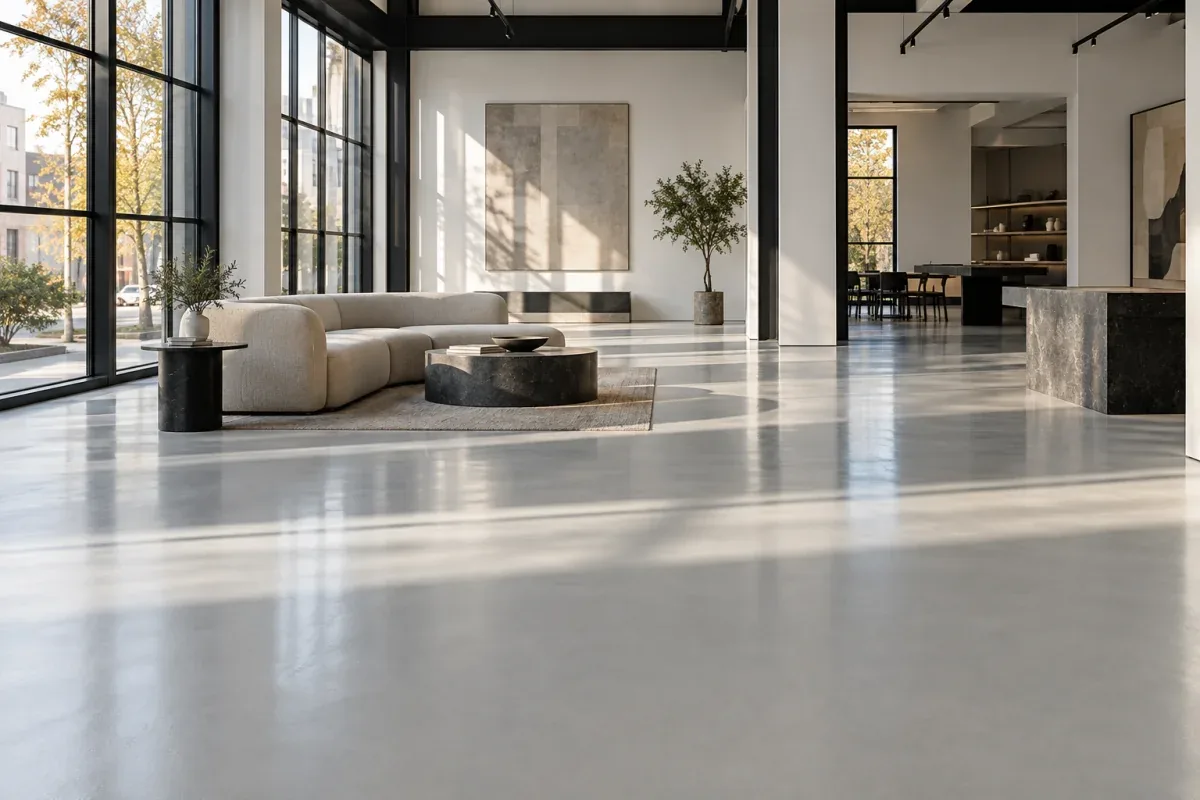
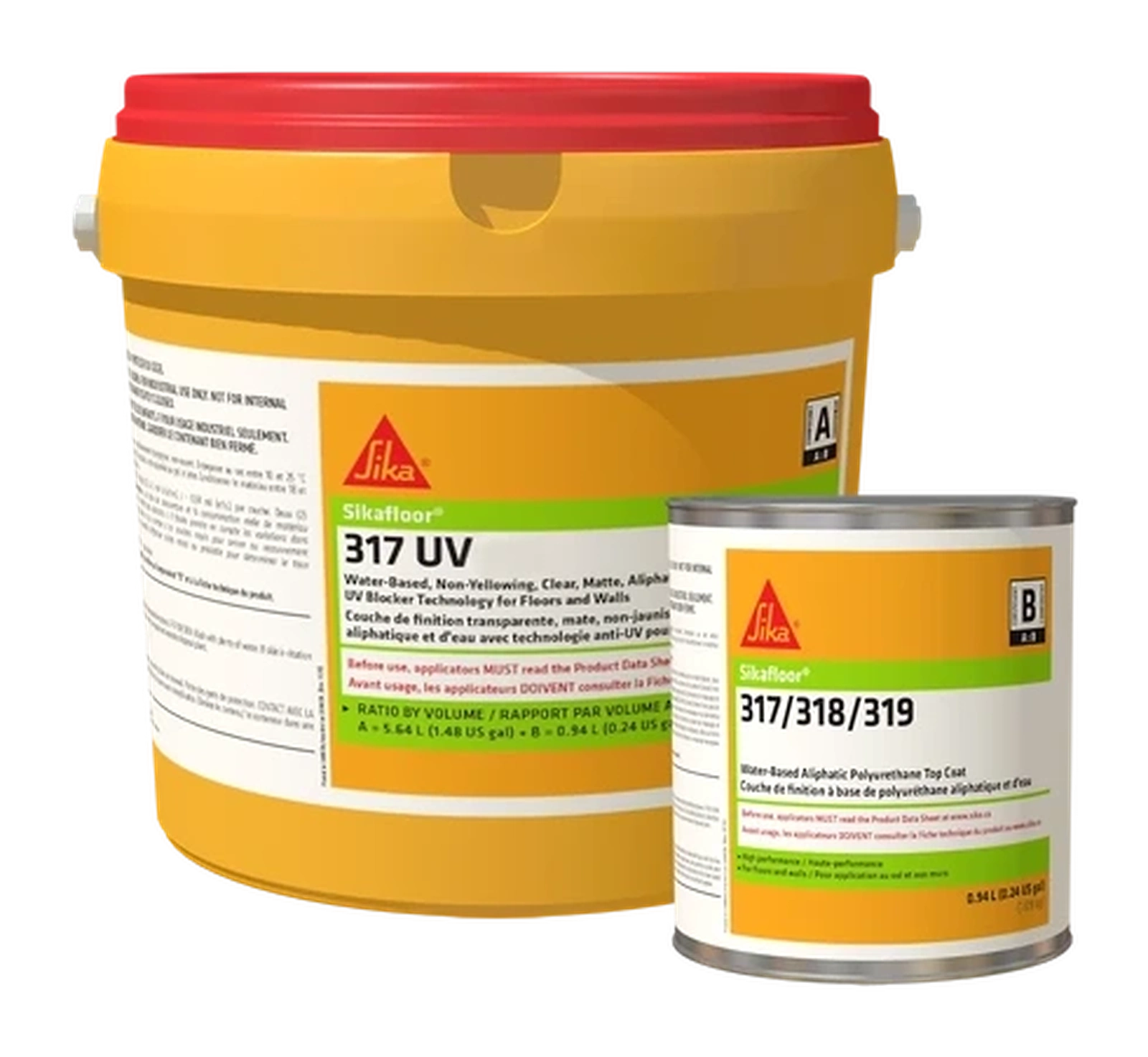
Sikafloor®-317 UV
Sikafloor®-317 UV is a two-component, water-borne, low odour, non-yellowing acrylic-aliphatic polyurethane topcoat.
Protective coatings.
Local knowledge.
KNOW THE
SURFACE.
PLAN THE
COATING.
Sikafloor®-317 UV is a two-component, water-borne, low odour, non-yellowing acrylic-aliphatic polyurethane topcoat.
Start with the surface, the existing finish and the way the space or equipment is used. Our team can help you work through product choices and the requirements for your project.
Get into the details
The surface.
Identify the material, its condition and the work you’re planning.
The system.
Confirm product suitability, preparation and compatibility with our team.
The conditions.
Check the current manufacturer instructions for application, installation or maintenance requirements.
THE DETAILS.
ALL HERE.
Keep the technical information close.
Use the current manufacturer documents when planning the work.
| Packaging | 6.58 L (1.73 US gal.) units. Components A+B in unitized carton. |
|---|---|
| APPROVALS / CERTIFICATES | Meets the requirements of CFIA for use in food plants. |
| Shelf Life | 6 months in original unopened packaging. |
| Storage Conditions | Store dry at temperatures between 10 °C to 25 °C (50 °F to 77 °F). Protect from freezing. If frozen, contact Sika Canada. |
| Volatile organic compound (VOC) content | ≤ 70 g/L |
| Viscosity | A+B: ~250 cPs |
| Solid content by volume | ~42 % |
| Abrasion Resistance | ~0,067 g loss: CS-17 wheel /1000 g /1000 cycles (ASTM D4060) |
| Chemical Resistance | Consult Sika Canada. |
| Coefficient of Friction | ~0.58 Wet (smooth matte) ~0.88 Dry (smooth matte) (ANSI A137.1 /ANSI A326.3) (DCOF - BOT 3000e) |
| Mixing Ratio | A:B = 6:1 by volume |
| Product Temperature | Condition product between 18 °C to 30 °C (65 °F to 86 °F) before use and during the application. |
| Ambient Air Temperature | Minimum: 15 °C (59 °F) / Maximum: 30 °C (86 °F) Note: Mixing carried out under conditions where the Sikafloor®-317 UV temperature and ambient temperature are below 18 °C (65 °F) will result in reduced product workability and slower curing rates. |
| Relative Air Humidity | Maximum: 75% (during application and curing) Sikafloor®-317 UV should not be applied when the Relative Humidity is greater than 75 % as curing times will be longer and water will be retained in the film reducing ultimate coating performance. Note: Water-borne products require moisture to evapourate from the film to cure to full properties. Provide adequate fresh air ventilation to remove the excess moisture from the curing product. |
| Dew Point | Substrate must be at least 3 °C (5 °F) above the Dew Point to reduce the risk of condensation, which may lead to adhesion failure or "blushing" on the floor finish. Be aware that the substrate temperature may be lower than the ambient temperature. |
| Substrate Temperature | Minimum: 15 °C (59 °F) / Maximum: 30 °C (86 °F) Note: Any attempt to apply Sikafloor®-317 UV at substrate temperature conditions less than 18 °C (65 °F) will result in an increase in viscosity and slower cure rates. |
| Pot Life | ~2 hours Note: Care must be taken not to use product beyond its recommended pot life. Material will appear liquid, but is unusable and will result in poor adhesion. |
| Curing Time | Dry to touch ~25 minutes Hard dry ~6 hours Light traffic ~8 hours Full cure ~7 days Notes: Curing times will vary according to air and substrate temperature and relative humidity. Protect from dampness, condensation and water contact during the initial 24 hour cure period. |
| Waiting Time / Overcoating | 23 °C (73 °F) Minimum ~8 hours Maximum 24 hours IMPORTANT: If the maximum waiting time has been exceeded. The previous coat must be lightly sanded, to remove all gloss; vacuum cleaning using a brush attachment followed promptly with a solvent wipe off the surface as per the following generally accepted practices: Avoid using solvent that can leave a oily residue : (such as, but not limited to most mineral spirit). Avoid Paper Towels: Pre-treated shop towels or standard paper towels may contain silicone or manufacturing additives that will ruin your paint job. Stick to lint-free cotton cloths or dedicated microfiber towels. Change Rags Frequently: As soon as a rag becomes visibly dirty, discard it or fold it to a clean side. Continuing to wipe with a saturated, dirty rag just re-deposits contaminants onto the surface. Wet Wipe: Pour a solvent (onto the first rag. Do not dip the rag into the solvent container; pour it directly to keep your supply clean). Lift: Wipe down a small, manageable section (e.g., ~0.5 m 2 [~ 4-6 ft 2 ]) of the surface. Use enough pressure to break up and lift the oils or sanding dust. Rotate the cloth frequently so you are always using a clean spot. Dry Wipe: Before the solvent can flash off (evaporate) and dry on the surface, wipe the same section with a second, clean, lint-free rag. When used correctly, this second cloth absorbs residual solvent and removes materials that could reduce or prevent adhesion or the proper performance of the next coat. |
| Consumption | 20 m 2 /L (800 ft 2 /US gal) at 2 mil (w.f.t.) / ~0.84 mil (d.f.t.) per coat. Two (2) coats are recommended. Note: Actual coverage rates and material consumption will depend upon porosity and profile of substrates. Allowance must also be made for variation in film thickness or number of coats required to achieve complete coverage of surfaces. Test sections are recommended to establish correct coverage. |
| SUBSTRATE QUALITY | Concrete surfaces must be clean and sound. The compressive strength of the concrete substrate should be at least 25 MPa (3625 psi) at 28 days and a minimum of 1.5 MPa (217 psi) in tensile strength, at the time of the application. |
| MIXING | Mixing ratio A:B = 6:1 (by volume) Important: Do not hand mix Sikafloor® products. Mechanical mix only. Mix full units only Pre-mix each component separately to ensure that any settled material is broken up and all solids are evenly distributed. Uniform clarity and consistencies must be achieved within each component. The container for Component A (resin) is partly filled and sized to allow use as the mixing vessel for a single unit. Start mixing Component A (resin) using a low-speed electric drill (300 - 400 rpm) fitted with an Exomixer® type paddle (recommended model), ensuring the paddle is kept within the resin to avoid air entrapment. Add Component B (hardener) to the vortex of the resin being mixed and blend for three (3) minutes until a uniform consistency is achieved. During the mixing operations, scrape down the sides and bottom of the container with a flat or straight edge trowel at least once to ensure complete mixing. Do not attempt to attend to unmixed material that may gather on the sides of the mixing container while mechanical or electrical parts are in motion. When completely mixed, Sikafloor®-317 UV should be uniform in colour and consistency. Note: Do not mix more material than can be applied within the working time limits (i.e. Pot Life) at the actual field temperature. |
| CLEAN UP | Clean tools and equipment immediately with water. Once hardened, product can only be removed mechanically. |
| Cure time | Dry to touch ~25 minutes Hard dry ~6 hours Light traffic ~8 hours Full cure ~7 days |
| Application temperature | Minimum: 15 °C (59 °F) / Maximum: 30 °C (86 °F) |
| VOC | ≤ 70 g/L |
KNOW BEFORE
YOU COAT.
Technical information.
Safety information.
Ready when you need it.
Sikafloor®-317 UV
Product Data Sheet (PDS) · Sikafloor®-317 UV
Read the full product requirements, application instructions and limitations.
Safety Data Sheet (SDS) · Sikafloor®-317 UV
Product safety and handling information.
Safety Data Sheet (SDS) · SDS Sikafloor®-317 UV Part A
Product safety and handling information.
Safety Data Sheet (SDS) · SDS Sikafloor®-317 UV /35 NA PurCem® Part A
Product safety and handling information.
Check the product label and current manufacturer documents for the exact component, colour and region before use.
Full product details, applications & manufacturer specifications
Sikafloor®-317 UV is a two-component, water-borne, low odour, non-yellowing acrylic-aliphatic polyurethane topcoat.
This high performance clear resin contains a unique UV blocker technology that provides superior ultraviolet light screening properties that significantly improves colour retention values of underlying resin floor systems. Sikafloor®-317 UV has excellent clarity applied as a matte finish which eliminates reflective gloss on general service or decorative Sikafloor® and Sikagard® resin floor and wall systems.
Recommended uses
Suitable for interior use as a gloss reduction topcoat for a variety of Sikafloor® systems in public and commercial buildings that include: Healthcare facilities; hospitals and clinics Research buildings: laboratories, and common areas Education: schools, colleges, and universities Retail spaces: grocery, and department stores Museums, banks, and institutional structures Offices and government buildings Manufacturing facilities and warehouses
Floors- Finish
Clear, matte
- Coverage
20 m 2 /L (800 ft 2 /US gal) at 2 mil (w.f.t.) / ~0.84 mil (d.f.t.) per coat. Two (2) coats are recommended. Note: Actual coverage rates and material consumption will depend upon porosity and profile of substrates. Allowance must also be made for variation in film thickness or number of coats required to achieve complete coverage of surfaces. Test sections are recommended to establish correct coverage.
- Drying time
Curing Time: Dry to touch ~25 minutes Hard dry ~6 hours Light traffic ~8 hours Full cure ~7 days Notes: Curing times will vary according to air and substrate temperature and relative humidity. Protect from dampness, condensation and water contact during the initial 24 hour cure period.
- Recoat time
View manufacturer details
23 °C (73 °F) Minimum ~8 hours Maximum 24 hours IMPORTANT: If the maximum waiting time has been exceeded. The previous coat must be lightly sanded, to remove all gloss; vacuum cleaning using a brush attachment followed promptly with a solvent wipe off the surface as per the following generally accepted practices: Avoid using solvent that can leave a oily residue : (such as, but not limited to most mineral spirit). Avoid Paper Towels: Pre-treated shop towels or standard paper towels may contain silicone or manufacturing additives that will ruin your paint job. Stick to lint-free cotton cloths or dedicated microfiber towels. Change Rags Frequently: As soon as a rag becomes visibly dirty, discard it or fold it to a clean side. Continuing to wipe with a saturated, dirty rag just re-deposits contaminants onto the surface. Wet Wipe: Pour a solvent (onto the first rag. Do not dip the rag into the solvent container; pour it directly to keep your supply clean). Lift: Wipe down a small, manageable section (e.g., ~0.5 m 2 [~ 4-6 ft 2 ]) of the surface. Use enough pressure to break up and lift the oils or sanding dust. Rotate the cloth frequently so you are always using a clean spot. Dry Wipe: Before the solvent can flash off (evaporate) and dry on the surface, wipe the same section with a second, clean, lint-free rag. When used correctly, this second cloth absorbs residual solvent and removes materials that could reduce or prevent adhesion or the proper performance of the next coat.
Use the sheet for your exact product code and finish. Coverage and times depend on the stated temperature, humidity, substrate and coat thickness.
Features
- Quick curing, tack-free and hard in less than one (1) hour for fast return to service.
- Unique UV blocker technology provides superior ultraviolet light screening properties that significantly improves colour retention values of underlying resin floor systems.
- Low reflective gloss improves visual definition of decorative floors, including multi-coloured quartz and multi-coloured flake systems.
- Compatible thermal shock resistance when applied over Sika® Ucrete® mortar systems.
- Good abrasion and impact resistance.
- Easily cleaned and maintained surface.
- Low odour formulation suitable for application in occupied facilities
- Packaging
- 6.58 L (1.73 US gal.) units. Components A+B in unitized carton.
- APPROVALS / CERTIFICATES
- Meets the requirements of CFIA for use in food plants.
- Shelf Life
- 6 months in original unopened packaging.
- Storage Conditions
- Store dry at temperatures between 10 °C to 25 °C (50 °F to 77 °F). Protect from freezing. If frozen, contact Sika Canada.
- Volatile organic compound (VOC) content
- ≤ 70 g/L
- Viscosity
- A+B: ~250 cPs
- Solid content by volume
- ~42 %
- Abrasion Resistance
- ~0,067 g loss: CS-17 wheel /1000 g /1000 cycles (ASTM D4060)
- Chemical Resistance
- Consult Sika Canada.
- Coefficient of Friction
- ~0.58 Wet (smooth matte) ~0.88 Dry (smooth matte) (ANSI A137.1 /ANSI A326.3) (DCOF - BOT 3000e)
- Mixing Ratio
- A:B = 6:1 by volume
- Product Temperature
- Condition product between 18 °C to 30 °C (65 °F to 86 °F) before use and during the application.
- Ambient Air Temperature
- Minimum: 15 °C (59 °F) / Maximum: 30 °C (86 °F) Note: Mixing carried out under conditions where the Sikafloor®-317 UV temperature and ambient temperature are below 18 °C (65 °F) will result in reduced product workability and slower curing rates.
- Relative Air Humidity
- Maximum: 75% (during application and curing) Sikafloor®-317 UV should not be applied when the Relative Humidity is greater than 75 % as curing times will be longer and water will be retained in the film reducing ultimate coating performance. Note: Water-borne products require moisture to evapourate from the film to cure to full properties. Provide adequate fresh air ventilation to remove the excess moisture from the curing product.
- Dew Point
- Substrate must be at least 3 °C (5 °F) above the Dew Point to reduce the risk of condensation, which may lead to adhesion failure or "blushing" on the floor finish. Be aware that the substrate temperature may be lower than the ambient temperature.
- Substrate Temperature
- Minimum: 15 °C (59 °F) / Maximum: 30 °C (86 °F) Note: Any attempt to apply Sikafloor®-317 UV at substrate temperature conditions less than 18 °C (65 °F) will result in an increase in viscosity and slower cure rates.
- Pot Life
- ~2 hours Note: Care must be taken not to use product beyond its recommended pot life. Material will appear liquid, but is unusable and will result in poor adhesion.
- Curing Time
- Dry to touch ~25 minutes Hard dry ~6 hours Light traffic ~8 hours Full cure ~7 days Notes: Curing times will vary according to air and substrate temperature and relative humidity. Protect from dampness, condensation and water contact during the initial 24 hour cure period.
- Waiting Time / Overcoating
- 23 °C (73 °F) Minimum ~8 hours Maximum 24 hours IMPORTANT: If the maximum waiting time has been exceeded. The previous coat must be lightly sanded, to remove all gloss; vacuum cleaning using a brush attachment followed promptly with a solvent wipe off the surface as per the following generally accepted practices: Avoid using solvent that can leave a oily residue : (such as, but not limited to most mineral spirit). Avoid Paper Towels: Pre-treated shop towels or standard paper towels may contain silicone or manufacturing additives that will ruin your paint job. Stick to lint-free cotton cloths or dedicated microfiber towels. Change Rags Frequently: As soon as a rag becomes visibly dirty, discard it or fold it to a clean side. Continuing to wipe with a saturated, dirty rag just re-deposits contaminants onto the surface. Wet Wipe: Pour a solvent (onto the first rag. Do not dip the rag into the solvent container; pour it directly to keep your supply clean). Lift: Wipe down a small, manageable section (e.g., ~0.5 m 2 [~ 4-6 ft 2 ]) of the surface. Use enough pressure to break up and lift the oils or sanding dust. Rotate the cloth frequently so you are always using a clean spot. Dry Wipe: Before the solvent can flash off (evaporate) and dry on the surface, wipe the same section with a second, clean, lint-free rag. When used correctly, this second cloth absorbs residual solvent and removes materials that could reduce or prevent adhesion or the proper performance of the next coat.
- Consumption
- 20 m 2 /L (800 ft 2 /US gal) at 2 mil (w.f.t.) / ~0.84 mil (d.f.t.) per coat. Two (2) coats are recommended. Note: Actual coverage rates and material consumption will depend upon porosity and profile of substrates. Allowance must also be made for variation in film thickness or number of coats required to achieve complete coverage of surfaces. Test sections are recommended to establish correct coverage.
- SUBSTRATE QUALITY
- Concrete surfaces must be clean and sound. The compressive strength of the concrete substrate should be at least 25 MPa (3625 psi) at 28 days and a minimum of 1.5 MPa (217 psi) in tensile strength, at the time of the application.
- MIXING
- Mixing ratio A:B = 6:1 (by volume) Important: Do not hand mix Sikafloor® products. Mechanical mix only. Mix full units only Pre-mix each component separately to ensure that any settled material is broken up and all solids are evenly distributed. Uniform clarity and consistencies must be achieved within each component. The container for Component A (resin) is partly filled and sized to allow use as the mixing vessel for a single unit. Start mixing Component A (resin) using a low-speed electric drill (300 - 400 rpm) fitted with an Exomixer® type paddle (recommended model), ensuring the paddle is kept within the resin to avoid air entrapment. Add Component B (hardener) to the vortex of the resin being mixed and blend for three (3) minutes until a uniform consistency is achieved. During the mixing operations, scrape down the sides and bottom of the container with a flat or straight edge trowel at least once to ensure complete mixing. Do not attempt to attend to unmixed material that may gather on the sides of the mixing container while mechanical or electrical parts are in motion. When completely mixed, Sikafloor®-317 UV should be uniform in colour and consistency. Note: Do not mix more material than can be applied within the working time limits (i.e. Pot Life) at the actual field temperature.
- CLEAN UP
- Clean tools and equipment immediately with water. Once hardened, product can only be removed mechanically.
- Cure time
- Dry to touch ~25 minutes Hard dry ~6 hours Light traffic ~8 hours Full cure ~7 days
- Application temperature
- Minimum: 15 °C (59 °F) / Maximum: 30 °C (86 °F)
- VOC
- ≤ 70 g/L
Colours &
finish options.
Explore the published colour and finish information for this product.
Clear, matte
Confirm the colour, finish and availability with our team and a physical sample.
Explore related categories
BIG PROJECT?
LET’S TALK.
Share the surface, its condition and what it needs to stand up to. We’ll help you work through the product choices and preparation.
Ask about Sikafloor®-317 UV